

If you've been hearing that AI is killing Google and wondering what it means for your landscaping business, this episode cuts through the noise with actual data. Host Jack Jostes — CEO of Ramblin Jackson and a nearly 20-year veteran of local SEO — is sharing an excerpt from his upcoming book, Tree of Good Fortune: The Landscaper's Guide to Direct Response Marketing, and the message is clear: Google isn't dying. In 2025, Alphabet crossed $400 billion in annual revenue for the first time, and Google's Gemini AI is now powering Apple's Siri through a landmark multi-year partnership. What has changed is how search results look: AI Overviews have caused a measurable drop in website click-through rates, and the businesses winning in this new environment are the ones being cited inside those AI summaries — which happens to require the same strong digital foundation that good local SEO has always demanded. Jack breaks down what's actually shifting in search, why ChatGPT needed $110 billion in outside funding just to keep operating, what Rand Fishkin's research reveals about tracking your "AI rank" (spoiler: don't bother), and why the Foundational Four — your branding, website, local SEO, and reviews — matters more now than ever.
Connect With Jack Jostes and Ramblin Jackson:
🌳 Ramblin Jackson: https://ramblinjackson.com/
👤 Connect with Jack Jostes: https://www.linkedin.com/in/jackjostes/
📸 Jack Jostes on Instagram: https://www.instagram.com/jackjostes/
🏢 Ramblin Jackson on Instagram: https://www.instagram.com/ramblinjackson/
👍 Ramblin Jackson on Facebook: https://www.facebook.com/RamblinJackson/
Schedule a 15-Minute Marketing Brainstorm with the Ramblin Jackson strategy team https://landscapersguide.com/brainstorm/
Is Google Going Away?
If you've been running your landscaping business for any length of time, you've probably heard it: AI is killing Google. Google is done. SEO is dead. ChatGPT is going to replace search.
I want to talk about that today — because I've spent a lot of time looking at the actual data, and the reality is a lot more nuanced than the noise online.
Here's what's actually true: the search results page looks completely different than it did a few years ago. Fewer people are clicking through to websites. And AI is changing how your customers find local businesses.
But Google going away? That's not what the numbers show. And more importantly — for landscape business owners — the path to getting found hasn't actually changed as much as you might think.
That's what we're getting into today.
Welcome To The Landscaper’s Guide Podcast
Welcome to the Landscapers Guide Podcast. I'm Jack Jostes, CEO of Ramblin Jackson — a digital marketing agency focused exclusively on the landscape and snow industry. We're a fully remote team, and I personally use AI in my own business every day — with my sales team, in our marketing, and in how we serve our clients.
Before we get into it, I want to let you know that this episode is adapted from a chapter in my upcoming book — Tree of Good Fortune: The Landscaper's Guide to Direct Response Marketing. It's the second edition, and I'll be announcing the release date this summer. If you want to be the first to know, go to landscapersguide.com/podcast and join my email list. Check the show notes for a link to that
Alright — let's get into it.
The Search Results Page Doesn't Look Like It Used To
Let's start with what you've probably already noticed: getting found online feels different than it used to.
Not long ago, when someone Googled 'landscape company near me,' they'd see a pretty predictable page. A few ads at the top, a map with three local businesses pinned to it, and then ten blue links below. That was the whole game. Rank in the map pack, rank in the organic results, get found.
Today's search results page has been almost entirely rearranged. You'll typically see ads — more of them, and placed more aggressively — followed by an AI Overview that tries to answer the searcher's question without them ever clicking a link. Then some map results. Then more ads. Then, somewhere further down the page, the traditional organic results. And at the bottom, a prompt inviting the user to ask a follow-up question — all without leaving Google.
This matters because it's caused a measurable drop in the number of people who actually click through to websites. A study by Seer Interactive — analyzing over 25 million organic impressions across 42 organizations — found that organic click-through rates for searches that triggered an AI Overview dropped from 1.76% to 0.61%. That's a 61% decline. And even for searches where no AI Overview appeared, organic click-through rates were still down 41% year over year.
So Google is getting more searches than ever. It's just sending fewer visitors to websites.
Here's the flip side though — and this is important: businesses that were actually cited inside the AI Overview earned 35% more organic clicks and 91% more paid clicks than businesses that weren't cited. The game has shifted from 'rank on the page' to 'be the business the AI references in its answer.' And the path to being cited is the same path it's always been: a strong, consistent, trustworthy online presence.
AI Overviews: Google's Answer Before You Even Ask
When Google launched AI Overviews in 2024, it changed how search results look and feel. Instead of giving you a list of options, Google now tries to synthesize an answer right at the top of the page — pulling from multiple sources and presenting it as a single block of text.
For informational searches — 'how often should I aerate my lawn?' or 'what are the signs my sprinkler system needs repair?' — users may get their question answered without visiting any website at all.
But for local, transactional searches — 'best landscaping company near me' or 'who does snow removal in [city]?' — AI Overviews are less likely to completely answer the question. The map pack and local results still matter a lot here.
The takeaway: AI Overviews are a reason to focus more on your local and transactional visibility, not less.
The ChatGPT Situation And What The Money Actually Tells You
The Kleenex Effect
When ChatGPT launched in late 2022, it became a cultural phenomenon almost overnight. It was the first AI tool that felt accessible and useful to everyday people — not just engineers or researchers. Within months, 'ChatGPT' became the household name for AI the same way 'Kleenex' became the household name for facial tissue. You might reach for a Puffs, but you call it a Kleenex.
Fun side note I learned when my first book was edited: 'google' — when used as a verb — is spelled lowercase, because it became so dominant in search that it was added to the Merriam-Webster dictionary in 2006 as a verb meaning to search online.
I don't see 'Chat' becoming a verb the same way. But ChatGPT does have the most household name recognition of all the AI tools right now, and that matters for understanding all the noise about AI replacing Google.
$110 Billion — What That Number Actually Means
In February 2026, OpenAI announced a $110 billion funding round — the largest private financing in history. Amazon committed $50 billion. Nvidia and SoftBank each invested $30 billion. OpenAI's valuation was listed at $730 billion. And the company is projecting revenues of $280 billion by 2030 — while burning through billions in computing costs today.
That level of investment tells you two things at the same time: people believe AI is the future — and ChatGPT requires an extraordinary amount of capital just to keep the lights on. A company that needs $110 billion in outside funding to operate is in a very different financial position than a company generating $400 billion in annual revenue from advertising alone.
Which brings us to Google.
Google's Financial Fortress
There has been a tremendous amount of noise online suggesting that AI is killing Google search. The data tells a different story.
In 2025, Alphabet — Google's parent company — posted annual revenues of $402.8 billion. That's the first time they've exceeded $400 billion in a single year, and a 15% increase over the prior year. Google's revenue comes from search advertising, YouTube — which alone exceeded $60 billion for the year — Google Workspace, and Google Cloud, which is now running at over a $70 billion annual rate.
Google isn't fighting AI. It's funding AI — from a position of enormous financial strength. And it's embedding AI directly into the products that local businesses already depend on: Google Search, Google Maps, and increasingly through a landmark partnership with Apple.
The Big Movie: Gemini and the iPhone
Here's what I find most significant about where AI is headed for local businesses: the dominant AI tool of the next several years may not be one that people consciously choose to download. It's one that will simply be built into the devices and platforms they already use every day.
Google's Gemini AI is already embedded in Google Search — as AI Overviews — and in Google Maps, where it helps users discover local businesses, answer questions about hours and services, and summarize reviews.
And then, in January 2026, something pretty significant happened. Apple and Google announced a multi-year partnership where Google's Gemini models would serve as the foundation for future Apple Intelligence features — including an overhauled version of Siri. Apple determined that Google's AI technology provided the most capable foundation for its needs and agreed to pay Google approximately $1 billion per year for access.
To put that in context: the iPhone is the most widely used smartphone in America. When someone asks Siri to find a landscaper, a dentist, or a pizza place nearby, the intelligence powering that recommendation will increasingly run on Google's Gemini. People won't choose Gemini. They'll just use their phone.
My prediction: Gemini becomes the dominant AI — not because people choose it, but because it's just there. I see Claude emerging as the dominant workplace AI for creating and building - while Gemini will be used for researching, searching, planning and more personal AI uses, including finding businesses. But that’s just my opinion at this time based on what I’m seeing.
How AI Actually Learns About Your Business
To understand why local SEO still matters so much in an AI-first world, it helps to understand how AI tools actually generate their answers about local businesses. They don't make things up from scratch. They extract, synthesize, and summarize.
When someone asks Google's AI Overview, ChatGPT, Claude, Gemini, or Perplexity about local businesses in a category — 'who does the best lawn care in [your city]?' — the AI is drawing from a specific set of data sources. For local businesses, those sources are:
Your website — the content, service descriptions, location pages, and trust signals that live there.
Your Google Business Profile — your category, services, photos, hours, and how you've responded to reviews.
Online reviews — Google reviews, but also Yelp, Facebook, industry directories, and first-party reviews on your own website.
Social media — your presence and activity on platforms where your business is mentioned.
Online mentions — press coverage, blog posts, directory listings, and any other place your business name and information appear.
All of this gets extracted, compressed, and displayed when the AI constructs its answer. The AI isn't visiting your website in real time. It's working from a model of your business built from everything that has ever been written about you online.
The businesses that show up well in AI results are the ones with the most consistent, complete, and positive digital footprint. A business with thin online presence, outdated listings, or unaddressed negative reviews is giving AI a muddy, incomplete, or unflattering picture.
Here's the key insight: feeding the algorithm and feeding the AI are the same activity.
A Note on Tracking Your 'AI Rankings'
You may have heard about companies offering to track your 'rank' inside AI tools like ChatGPT or Google's AI Overviews. Before you invest in any of those services, there's research you should know about.
In January 2026, Rand Fishk in published a study — one of the most respected researchers in the search industry — where 600 volunteers ran 12 different prompts through ChatGPT, Claude, and Google's AI Overview nearly 3,000 times. The finding was striking: there is less than a 1-in-100 chance that any of these AI tools, asked the same question 100 times, will give the same list of businesses in any two responses. When it comes to the order of results, it's closer to 1-in-1,000. Every list is essentially a new draw from a statistical lottery.
Fishkin's conclusion: tracking your 'rank' in AI tools is, at this point, nearly meaningless. And he warned that an industry of AI visibility 'experts' stands ready to sell you expensive tracking services built on unreliable metrics — much like the dubious SEO salespeople of years past.
What does matter? How often your business appears across many runs of the same prompt. Frequency is the meaningful signal — and it's driven by the same underlying signals that have always powered local SEO.
What Landscape Companies Should Actually Do
Here's the good news: the path forward is simpler than the noise online would have you believe.
The fundamentals of getting found — by Google, by AI, by potential customers — have not changed. The platforms have evolved, but the underlying principles are the same ones I've been teaching since the first edition of this book.
In the new book — and in future episodes — I'll walk through three key areas:
- Google Business Profile — the single most important local SEO asset for any local business
- On-Page SEO — how to optimize your website so that Google and AI understand who you are, where you operate, and what you do
- Off-Page SEO — how to build the authority and mentions that signal to search engines and AI that your business is trustworthy and established
Online reviews deserve a special mention. Reviews are one of the most powerful signals in both traditional local SEO and AI-generated results. When an AI tool synthesizes information about your business, reviews are among the first places it looks.
The Foundational Four — Still the Foundation
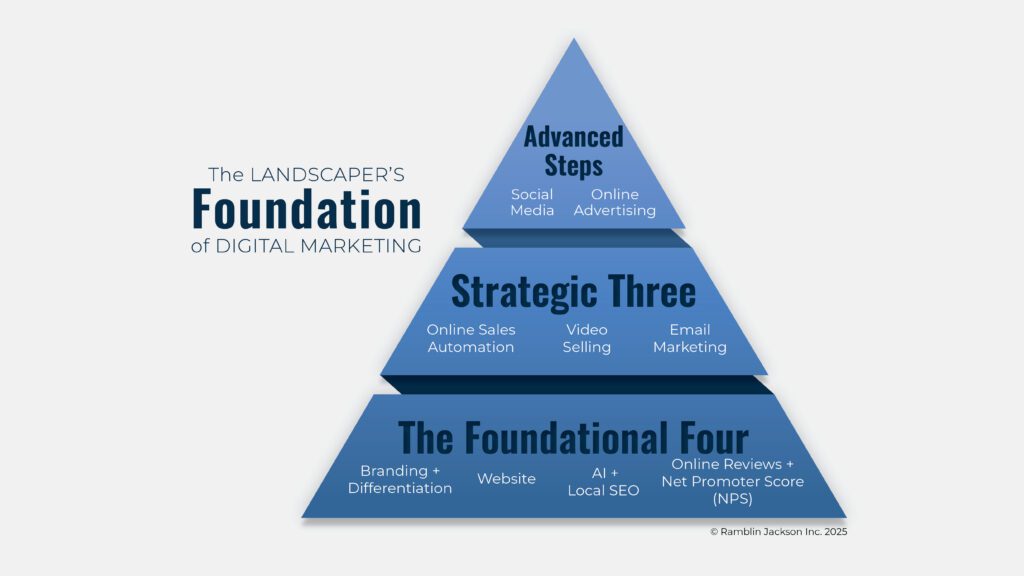
In many ways, the rise of AI has not disrupted the Foundational Four. It's reinforced it.
If you've heard me talk about this before, you know the Foundational Four is your branding and differentiation, your website design, your local SEO, and your online reviews. When one part is weak, the whole foundation is weak. When all four are strong, they feed each other.
What AI has done is make that interconnection more consequential. AI tools don't evaluate your business from a single source. They synthesize everything. A business with a strong, complete, consistent presence across all four pillars gives AI tools a clear, confident picture to work with. A business with gaps or weak spots gives AI a muddy picture — or worse, a reason to recommend a competitor.
The Foundational Four isn't just good marketing strategy. In the age of AI, it's how you control the story that gets told about your business when no one is watching.
Key Takeaways
Alright, that's a wrap on episode 316.
Quick summary of what we covered today:
AI is not killing Google — it's integrating with Google. And Google is funding it from a position of enormous financial strength.
Fewer people are clicking through to websites since AI Overviews launched — but if your business is actually cited inside an AI Overview, you get significantly more clicks, not fewer.
The signals AI uses to decide who to recommend are the same signals local SEO has always used — your website, your reviews, your Google Business Profile, and your mentions across the web.
And tracking your 'AI rank' is not meaningful right now. Focus on building the underlying presence, not gaming a metric.
This episode was adapted from a chapter in my upcoming book, Tree of Good Fortune: The Landscaper's Guide to Direct Response Marketing. It's the second edition, and it's coming out this summer. If you want to be the first to know when it's available — go to landscapersguide.com/podcast and join my email list.
Thanks for listening to the landscaper’s guide - my name’s Jack Jostes and I look forward to talking with you next week.
SOURCES
Seer Interactive / Search Engine Land — AI Overviews & Click-Through Rates (January 3, 2026)
searchengineland.com/google-ai-overviews-drive-drop-organic-paid-ctr-464212
Rand Fishkin / SparkToro — AI Inconsistency in Brand Recommendations (January 27, 2026)
sparktoro.com/blog/new-research-ais-are-highly-inconsistent...
Near Media Podcast — Rand Fishkin on AI Visibility vs. Google Rankings (Ep. 244)
nearmedia.co/ep-244-ai-visibility-vs-google-rankings-rand-fishkin...
OpenAI — $110B Funding Round & Amazon Partnership (February 27, 2026)
openai.com/index/amazon-partnership
cnbc.com — OpenAI $110B Funding Round
geekwire.com — Amazon Invests $50B in OpenAI
Alphabet Q4 2025 Earnings (February 4, 2026)
Alphabet Q4 2025 Earnings Release (PDF)
Apple & Google Gemini Partnership (January 12, 2026)
TechCrunch — Google's Gemini to Power Apple's AI Features Like Siri
CNBC — Apple Picks Google's Gemini to Run AI-Powered Siri
MacRumors — Apple's Google Gemini Deal Could Be Worth $5 Billion